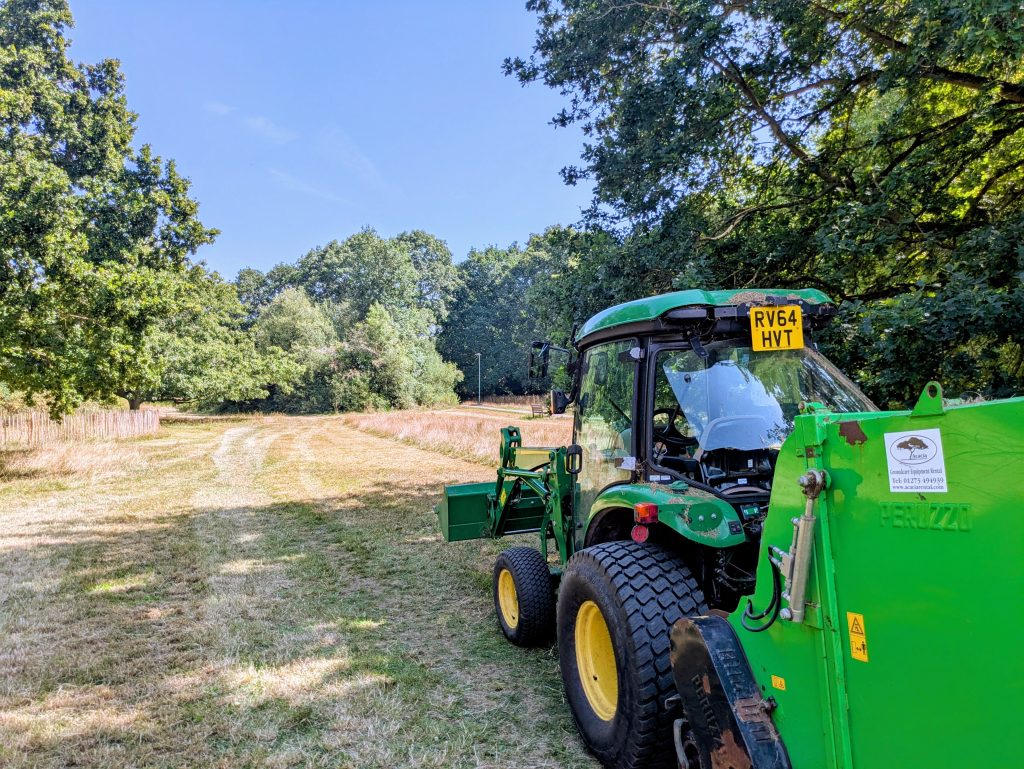
Conservation Mowing

Why do we mow?

Barnes Common overlies part of the Thames Terrace gravels meaning the soil is comprised of free-draining, acidic sands and gravels. This specific soil type is important as it is low in nutrients. Whilst this may sound like a negative, a wide array of plant species can only grow on poor soils including acid grassland species (see our Lowland Acid Grassland page) and many species of wildflower which means that sites like the Common are vital to populations of these unique plants.

Unfortunately, much of the grassland present on Barnes Common is classified as ‘improved’ or ‘neutral’ grassland. This means that the original sandy soils that naturally occur beneath the Common have been altered by either eutrophication (nutrification) of the soil or the natural succession of woodland.

Soil eutrophication can occur for a number of reasons but in urban sites it tends to occur as a result of pollution from car exhausts or dog fouling. The dumping of garden waste can also be a significant issue, not only nutrifying the soil but often introducing invasive species which can alter the delicate soil ecology.

Succession is the cumulative process by which the biological community within an ecosystem naturally evolves over time resulting in a climax community. In this case, succession transforms nutrient poor soils from grassland to heathland to scrub and finally to the climax community which is broadleaf woodland. This occurs as the soil is nutrified by the decay of organic matter from plants.

Historically, Barnes Common would have been grazed by livestock which would have prevented this succession by removing nutrients from the cycle, keeping the site as largely open heathland. However, without grazing, the eutrophication cycle progresses and our grassland is slowly disappearing into woodland.

‘Improved’, nutrient-rich soils do not support the same assemblages of rare and endangered plant species but instead encourage the growth of species-poor meadows of ‘coarse’ grass species. This brings us to the mowing. By mowing areas of grassland and removing the cuttings, disposing of them elsewhere, we halt the process of soil eutrophication thereby keeping the soil in its natural, nutrient-poor state. We are essentially acting as large herbivores in a functioning ecosystem, removing nutrients from the cycle.

Why mow some areas and not others?

The areas we choose to mow are often in the process of transitioning from species-rich grassland into a coarser, less diverse assemblage of plants. By mowing these areas, we hope to restore them to their former biodiverse glory. We also mow varying areas each year in an attempt to mimic the random, patchy nature of wild grazing. However, some areas are mown consistently every year to maintain their floral diversity.

Another key part of our mowing plan is ensuring that there is always some longer vegetation left in the meadows where we mow. This variation in sward height creates structural diversity which provides the key micro-habitats on which many invertebrates rely for food, shelter and a place to lay their eggs. Invertebrates are highly susceptible to changing vegetation length and tend to favour medium or long swards meaning that this uncut vegetation is vital to support healthy populations of invertebrates. Our aim is to create a diverse mosaic of varying sward heights whilst maintaining floral diversity.

Additionally, where possible, we mow later in the year. This preserves the nectar rich food plants which a large number of pollinators rely on. It also allows any insect larvae in the grass to complete the developmental stage of their life cycle and move on unharmed.

Where do we mow?

Every year we mow areas on Maisie’s meadow, Rocks Lane, Van Buren’s, Half and Half, The Orchard and Red Rover. Some mowing is usually carried out on Mill Hill but areas of acid grassland can be challenging to mow without damaging the ancient ant hills present here.

The Cricket Green, Black Poplar Meadow and Football Field are cut regularly by the council as amenity or sports meadows but this is not conservation mowing.

Why not grazing?

The obvious question after reading this is “why not grazing? Just get some cattle and let them do the mowing for you!”

It is true that conservation grazing is a key part of the management schemes of many nature reserves and is ideal for grassland maintenance. However, it is not suitable for a site like Barnes Common. For one thing, the Common is a small site and is crosscut by roads. There are few areas large enough to make the cost and logistics of hiring, transporting and containing a herd of cattle worthwhile and that is to say nothing of the risk of cattle escaping onto the roads!

Another issue is the public nature of the Common. So many people walk their dogs on the Common that a dog startling a cow would all to likely and could cause chaos.

Livestock hire is also remarkably difficult to come across in London and any cattle (or indeed other livestock animals) hired would have to be brought in daily as leaving them on the Common overnight, unsupervised is very risky.

Unfortunately, whilst grazing would be perfect for our grassland, it is simply too difficult logistically to be an effective long term solution.

Conservation Mowing

Why do we mow?

Barnes Common overlies part of the Thames Terrace gravels meaning the soil is comprised of free-draining, acidic sands and gravels. This specific soil type is important as it is low in nutrients. Whilst this may sound like a negative, a wide array of plant species can only grow on poor soils including acid grassland species (see our Lowland Acid Grassland page) and many species of wildflower which means that sites like the Common are vital to populations of these unique plants.

Unfortunately, much of the grassland present on Barnes Common is classified as ‘improved’ or ‘neutral’ grassland. This means that the original sandy soils that naturally occur beneath the Common have been altered by either eutrophication (nutrification) of the soil or the natural succession of woodland.

Soil eutrophication can occur for a number of reasons but in urban sites it tends to occur as a result of pollution from car exhausts or dog fouling. The dumping of garden waste can also be a significant issue, not only nutrifying the soil but often introducing invasive species which can alter the delicate soil ecology.

Succession is the cumulative process by which the biological community within an ecosystem naturally evolves over time resulting in a climax community. In this case, succession transforms nutrient poor soils from grassland to heathland to scrub and finally to the climax community which is broadleaf woodland. This occurs as the soil is nutrified by the decay of organic matter from plants.

Historically, Barnes Common would have been grazed by livestock which would have prevented this succession by removing nutrients from the cycle, keeping the site as largely open heathland. However, without grazing, the eutrophication cycle progresses and our grassland is slowly disappearing into woodland.

‘Improved’, nutrient-rich soils do not support the same assemblages of rare and endangered plant species but instead encourage the growth of species-poor meadows of ‘coarse’ grass species. This brings us to the mowing. By mowing areas of grassland and removing the cuttings, disposing of them elsewhere, we halt the process of soil eutrophication thereby keeping the soil in its natural, nutrient-poor state. We are essentially acting as large herbivores in a functioning ecosystem, removing nutrients from the cycle.

Why mow some areas and not others?

The areas we choose to mow are often in the process of transitioning from species-rich grassland into a coarser, less diverse assemblage of plants. By mowing these areas, we hope to restore them to their former biodiverse glory. We also mow varying areas each year in an attempt to mimic the random, patchy nature of wild grazing. However, some areas are mown consistently every year to maintain their floral diversity.

Another key part of our mowing plan is ensuring that there is always some longer vegetation left in the meadows where we mow. This variation in sward height creates structural diversity which provides the key micro-habitats on which many invertebrates rely for food, shelter and a place to lay their eggs. Invertebrates are highly susceptible to changing vegetation length and tend to favour medium or long swards meaning that this uncut vegetation is vital to support healthy populations of invertebrates. Our aim is to create a diverse mosaic of varying sward heights whilst maintaining floral diversity.

Additionally, where possible, we mow later in the year. This preserves the nectar rich food plants which a large number of pollinators rely on. It also allows any insect larvae in the grass to complete the developmental stage of their life cycle and move on unharmed.

Where do we mow?

Every year we mow areas on Maisie’s meadow, Rocks Lane, Van Buren’s, Half and Half, The Orchard and Red Rover. Some mowing is usually carried out on Mill Hill but areas of acid grassland can be challenging to mow without damaging the ancient ant hills present here.

The Cricket Green, Black Poplar Meadow and Football Field are cut regularly by the council as amenity or sports meadows but this is not conservation mowing.

Why not grazing?

The obvious question after reading this is “why not grazing? Just get some cattle and let them do the mowing for you!”

It is true that conservation grazing is a key part of the management schemes of many nature reserves and is ideal for grassland maintenance. However, it is not suitable for a site like Barnes Common. For one thing, the Common is a small site and is crosscut by roads. There are few areas large enough to make the cost and logistics of hiring, transporting and containing a herd of cattle worthwhile and that is to say nothing of the risk of cattle escaping onto the roads!

Another issue is the public nature of the Common. So many people walk their dogs on the Common that a dog startling a cow would all to likely and could cause chaos.

Livestock hire is also remarkably difficult to come across in London and any cattle (or indeed other livestock animals) hired would have to be brought in daily as leaving them on the Common overnight, unsupervised is very risky.

Unfortunately, whilst grazing would be perfect for our grassland, it is simply too difficult logistically to be an effective long term solution.

Acid Grassland

Dogs on Barnes Common

Habitat Management