

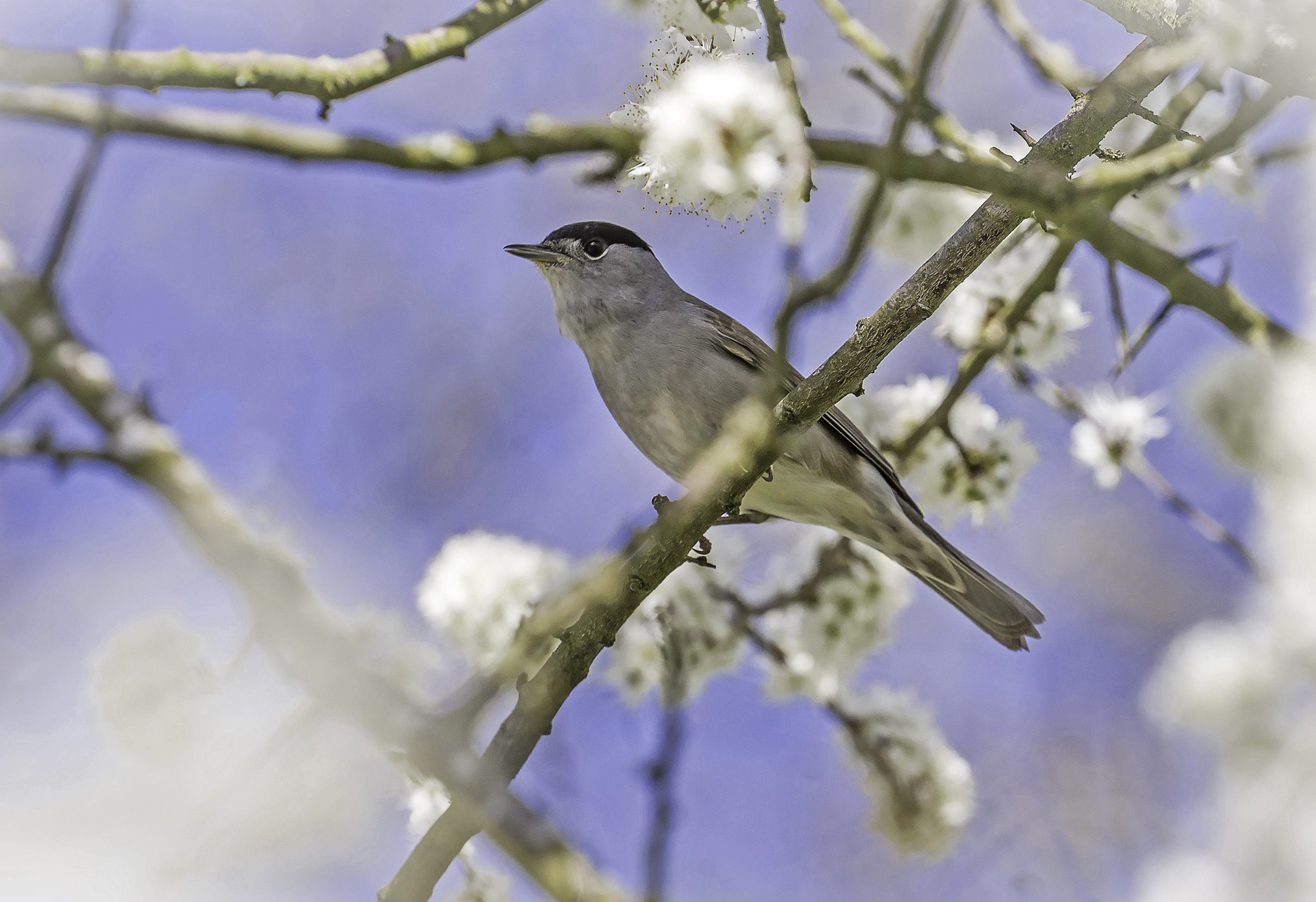
Usually, the first to announce its presence is the Common Chiffchaff (Phylloscopus collybita) with its onomatopoeic, two-note call. Around 2.5 million will be arriving in the UK during March and April, having spent their winters in the Mediterranean and Western Africa.
Regular pairs usually set up territories at the Ups and Downs, Mill Hill and Van Buren’s Meadow with the Common probably supporting around six to ten pairs altogether. Chiffchaffs are ground nesters, often in dense tussocky grass, so they can be very sensitive to disturbance and predators.
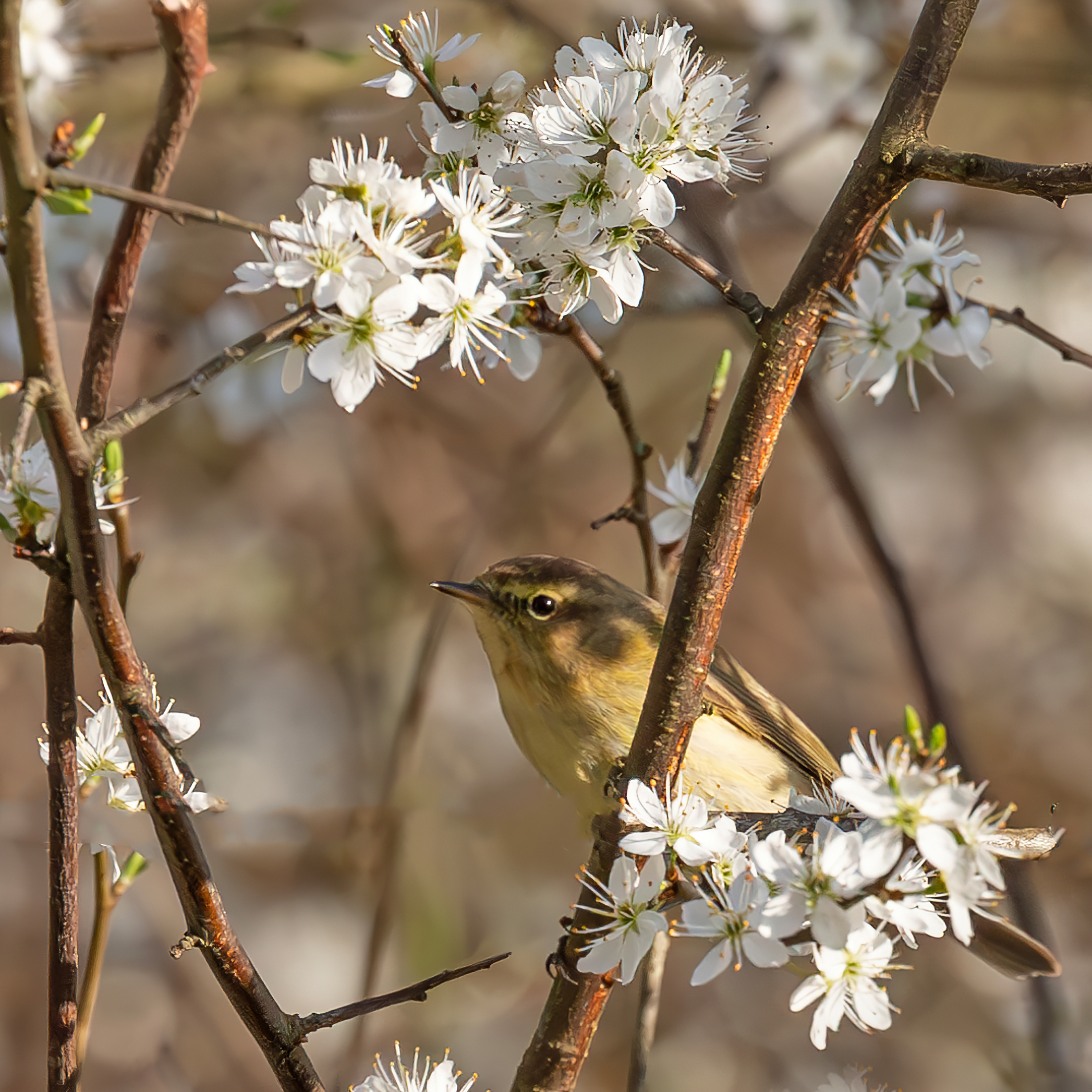
The next songster to arrive on our Commons is the Eurasian Blackcap (Sylvia atricapilla). The majority spend our winters in southern Europe and north Africa, although they can now be seen in the UK all year round with birds that breed in Germany and Eastern Europe spending the winter here.
The Blackcap’s delightful, very clear and fluting song has earned it the name of ‘northern nightingale’ and can generally be heard in the more wooded parts of the Common. They are very efficient at spreading mistletoe seeds, eating the flesh of the berry and wiping the seed on a branch, allowing it to potentially germinate there.
We will be heading out on our not-so-early Dawn Chorus Walk on 26th April to listen for birdsong – join us!
Our other main migrant usually arrives much later in late April and early May, bringing the promise of summer! Swifts (Apus apus) arrive back in Barnes after their long migration from Africa where they winter. They then use the cavities and crevices in our houses and rooves as nesting sites to raise their chicks before flying back to Africa in late summer. Local residents may be most familiar with Swifts when their ‘screaming parties’ of adults and youngsters hurtle around Barnes at breakneck speed in July and August.
Swifts are renowned as superb flyers and can travel up to 500 miles a day, spending most of their lives on the wing, feeding, sleeping and mating. It is also possible that they may be able to ‘snooze’ with one side of their brain asleep and then switch to the other side.
However, Swifts have suffered a dramatic decline in recent decades, perhaps 50% in the last 20 years. Reduction in insects due to pollution and pesticides, habitat destruction and the modernisation of many buildings where they used to nest are all factors.
An inaugural Barnes Swift group has been set up and is currently awaiting news on potential funding. However, if you would like to be involved, have any information on where Swifts nest each year or are interested in putting up some boxes on your house perhaps, please do get in touch and let us know – email Adrian.