

Barnes Common frequently receives enquires from people who want to make their gardens more sustainable, and here, we respond to some of these queries. If you have a question you would like us to feature – whether related to food growing or sustainable gardening in general – please contact Nicky. If you have tried these ideas at home, let us know how it goes!
This month, we tackle a question that was raised at a recent growers’ workshop – what is a forest garden and how do I apply the principles at home?
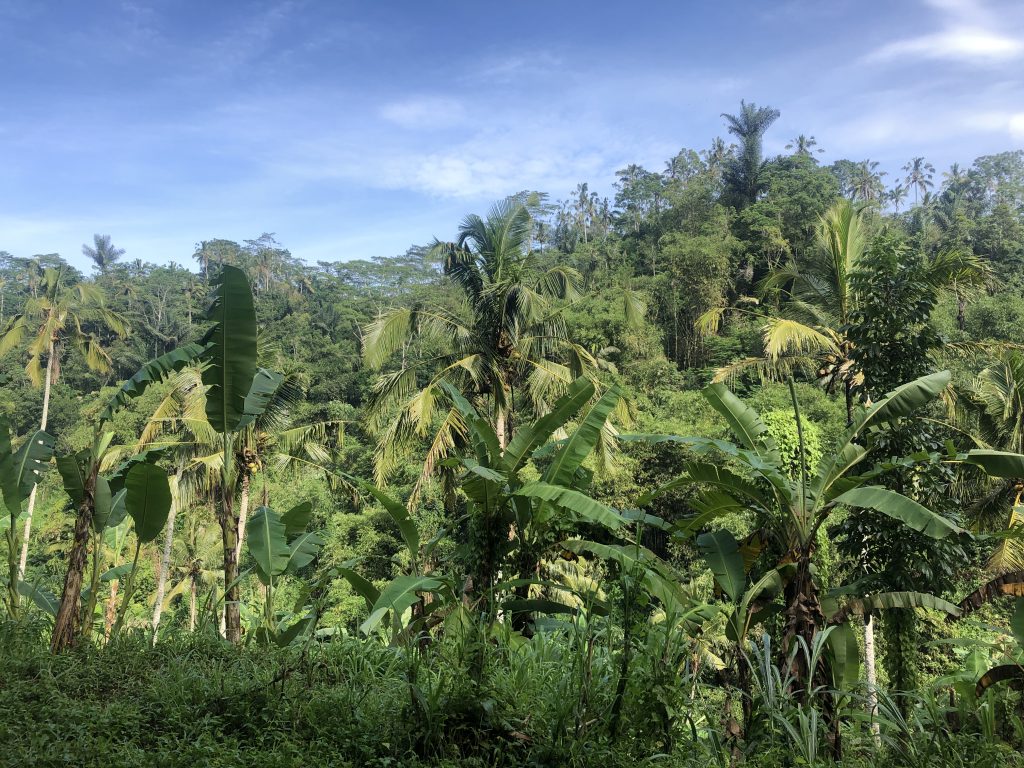
A forest garden is designed to mimic the structure of a natural forest, the idea being that the forest ecosystem is both stable and sustainable. Forest gardens are designed to be productive and low maintenance systems, combining a variety of useful and edible plants. A natural forest has a variety of different layers; a canopy layer, understory, shrub layer and so on. In a forest garden, you might recreate this by planting, for example, large trees with climbers growing up them, smaller trees and shrubs underneath and ground cover plants to retain moisture and smother weeds. Nitrogen accumulators are often included too. In addition, forest gardeners consider the ‘rhizosphere’, including root crops and beneficial fungi.
Forest gardens have long been a feature of tropical ecosystems, where high light levels mean there is a good amount of sunlight even at the forest floor. They have been introduced to temperate ecosystems more recently, where lower light levels mean that the shrub and forest floor layer need to be chosen carefully to tolerate the shady conditions. In many large-scale forest gardens, ‘clearings’ are created so that light can reach the ground.
Forest gardens are made up of mainly perennial plants. Plants are selected because they are multi-use; for example, a tree might provide a crop of nuts, timber, habitat for wildlife and support for a climber. This can be an opportunity to try new and unusual food crops. For example, did you know that Hylotelephium spectibile (Sedum), commonly used as an ornamental in gardens, has lemony leaves that can be used fresh in a salad?
Most of us do not have the space to plant a food forest in the back garden! We can still put these principles into action though. For example, if there is space to plant a small fruit tree in your garden, consider creating a ‘tree guild’. Using similar principles to a forest garden, this involves underplanting the tree with beneficial companion plants. For example, you might plant an apple tree, and underplant with comfrey to act as a nitrogen fixer and a nutritious ‘chop and drop’ mulch, daffodils to supress grass and attract pollinators and bee balm, dill or fennel to attract pollinators and repel pests. If there’s space, you could also add in a currant bush.
This creates a system where there are multiple positive interactions between each element. If you are growing in an even smaller space, such as on a balcony, and cannot include any trees, it is still possible to apply the principles of companion planting – growing lavender near tomatoes, for example, to attract pollinators.
If you would like to find out more, Edible Landscapes in Finsbury Park have some great resources and plant lists, and The Agroforestry Research Trust website contains a wealth of information.
Previous blogs: