

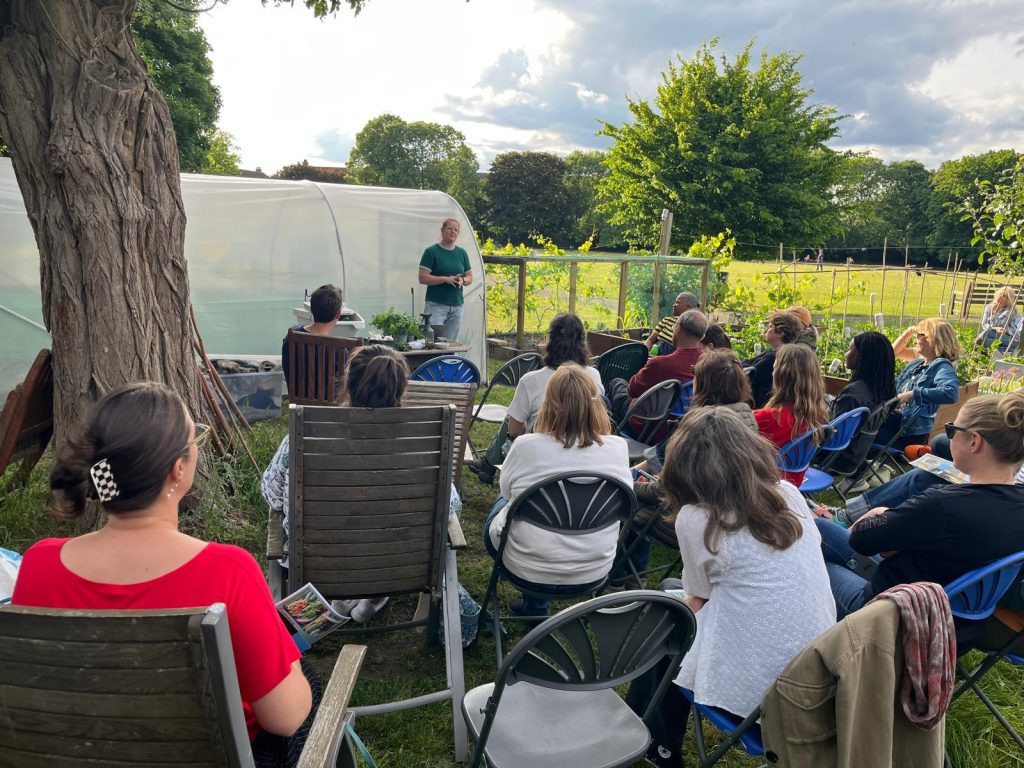
Barnes Common as an organisation has always been firmly based within the local community. Nature conservation, biodiversity, wellbeing and lifelong learning “for all” are at the heart of what we do. It is no surprise, then, that we often have discussions about what community means. How do we create spaces that are welcoming, open and inclusive for everyone?
At the Community Growing Project, this is something we talk about a lot. We describe the project as being ‘regenerative’, and whilst this relates in part to taking care of the natural environment, it also relates to people. Regenerative growing in its truest sense addresses questions of access and inequality. For example, who has access to green space and who doesn’t? Who can access fresh, healthy food and who can’t? Whose voices are included and whose are excluded? It is important, therefore, that we think not only about how we’re growing, but also who is doing the growing, and who benefits.
So, how can we address these imbalances? One way we try to do this at the Community Growing Project is by actively welcoming in groups of people who might otherwise not have the opportunity to take part in growing. Adults with mental health difficulties, those with physical disabilities and older adults are all groups who have been documented to have poorer health outcomes, and less access to green space, than the general population. We have recently tried to make the project more accessible for those with a physical disability, and you can read more about this here. We have a long-standing partnership with Richmond Borough Mind, whose clients attend on a monthly basis to garden and socialise together. We recently ran an ‘Introduction to Growing’ course in partnership with Age UK Richmond, which again, provided the opportunity for both nature connection and social connection.
Another group documented to have unequal access to green space is the LGBTQ+ community. June is Pride Month, and so it is a good time to celebrate the contribution the LGBTQ+ growing group make to the project! The group provides a safe, welcoming and inclusive space for members of the community who want to grow and learn together. Recently, we have run sessions in partnership with other organisations, and over the course of these sessions, some really interesting conversations arose around the theme of community.
In May, ‘Queer Girls’ Book Club’ visited the project, planting up summer crops in the polytunnel and making fresh herbal teas. During the session, we began to talk about the way in which London is often portrayed as an anonymous and unfriendly city, full of people who don’t want to interact with each other. However, everyone felt strongly that there are in fact lots of people who want to create community, and who actively seek it out. We discussed how shared interests – such as reading, or growing – can be a great catalyst for creating a space where social connections and shared learning can flourish.
In April, a group from Antidote visited the project. Antidote are a charity supporting the health and wellbeing of LGBTQ+ adults in London. Again, in the course of the growing activities, conversations arose about how important social connection, and connection with nature, can be in supporting the wellbeing of the LGBTQ+ community. One person reflected on the way in which members of the community who were affected by the AIDS pandemic in the 80s and 90s now find their mental health suffering retrospectively. They felt that being able to take part in activities such as growing, in a safe space, was a really important way of building personal wellbeing and community resilience. It is really interesting to see how conversations like these arise organically through the action of growing. People are able to connect with nature, and with each other.
If creating healthy and resilient communities is a topic you would like to explore more, then do have a look at our summer series of walks, talks and workshops. We have some fantastic external speakers, who will encourage you to see nature and food growing in new and unique ways. Everything is free to attend, but booking is essential – click here to see all events.