

Barnes Common frequently receives enquires from people who want to make their gardens more sustainable, and here, we respond to some of these queries. If you have a question you would like us to feature – whether related to food growing or sustainable gardening in general – please contact Nicky. If you have tried these ideas at home, let us know how it goes!
This month we address the question, “how do I ensure my planting scheme is pollinator-friendly”?
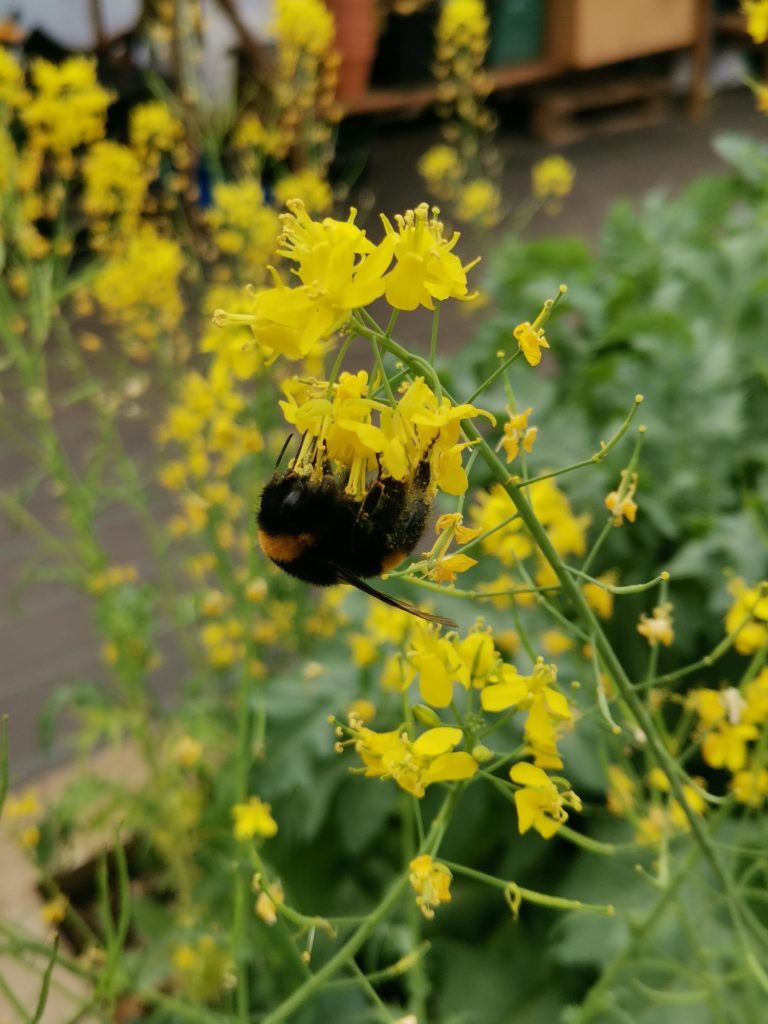
There are a huge variety of plants that pollinators love, and a quick Google search will give you an extensive list. Here we’ll focus on some general principles that will help make your garden more pollinator-friendly.
One key thing you can do is prolong the flowering season for as long as possible. Having flowers early and late in the season will ensure that your garden provides a source of forage when it is otherwise scarce. This takes a little bit of planning – when choosing plants, think about not only whether they will flower, but when they will flower. There are some lovely winter-flowering shrubs available, such as winter-flowering honeysuckle, and equally, some perennials (salvias for example) keep going long into the autumn.
Having variety in the colour and shape of the flowers you plant is important. Different pollinators will be attracted to different colours. Tubular-shaped flowers will attract long-tongued bees and butterflies, whereas daisy-shaped flowers are suitable for smaller insects. Not all pollinators can access pollen from all flowers, so to ensure you are reaching a diversity of creatures, try to include lots of variety. It’s also a good idea (both in planting for pollinators and in terms of garden design!) to plant in groups or drifts. This will ensure that colours and scents are easier to detect. Herbs, with their flowers and scents, are particularly valuable. Having night-scented plants also helps to attract a greater variety of moths.
There has long been a general consensus in horticulture that native species are more environmentally beneficial. Native species do indeed have an important role to play in creating a wildlife-friendly garden, but it is important to look at the nuance of this. Research has suggested that whilst it is important to have native plants in the garden, having a general spread of plants from the northern hemisphere is an effective strategy for attracting wildlife. Some exotics will also add value; helping to extend the flowering season, and providing additional shapes and colours. The more flowers your garden includes, whatever their origin, the more pollinators you will attract.
Companion planting is a technique whereby several different plants are grouped together because they offer each other mutual benefits. For example, in the Community Growing Project, we grow marigolds alongside tomatoes because they attract pollinators and repel pests. Adding some lavender to your veg patch can also be an effective way of drawing pollinators to the space. Borage and comfrey are particularly effective companion plants if you have space for them – and they can also be used as a natural fertiliser.
Remember that you don’t have to buy all of these plants – letting wildflowers grow in your lawn or your flower beds is a really effective way of attracting more pollinators to the garden. Plants we commonly dig up, such as buttercups, alkanet and dandelions, are really important sources of forage for pollinators. Consider leaving patches to grow.
Finally, as with many tasks in gardening, observation is key. What works in one space will not necessarily work in another, so take the time to have a look at what is happening in your garden. Are there particular plants that are always covered in bees? Are there plants in your neighbourhood that pollinators seem particularly keen on, and could you include them in your garden? Observing and adjusting can be a continual process, enabling you to create a pollinator heaven in your growing space!
Previous blogs: