


Barnes Common frequently receives enquires from people who want to make their gardens more sustainable, and here, we respond to some of these queries. If you have a question you would like us to feature – whether related to food growing or sustainable gardening in general – please contact Nicky. If you have tried these ideas at home, let us know how it goes!
At a recent growers’ workshop, a participant asked how to tell what would grow well in their garden. Sometimes, it can be tempting to choose the plants we like and simply put them in the ground, but that doesn’t always lead to success if they’re not suited to the conditions we have. It’s worth taking some time to understand your growing space, so that you can choose plants that are more likely to thrive.
Permaculture can give us some pointers here. Permaculture is a way of growing that encourages us to work with nature. Practitioners use a set of 12 ‘permaculture principles’ which can be applied to any space. The key principle in this instance is ‘observe and interact’ – rather than jumping into ‘doing’, permaculture encourages us to take a step back and observe our space first. Indeed, some practitioners advocate doing nothing for a full year in order to understand what the space is like during all seasons. Even a very small garden can be a complex ecosystem with numerous interacting elements. Whilst we might not have the time (or the patience!) to leave our growing space alone for a whole year, the principle remains a good one – it is helpful to understand what is going on in our gardens. Is there a sunny spot, a frost pocket or a boggy area, for example?
One way to make sense of the observations we make is to use a technique called sector planning. Sector planning is a way of highlighting all of the different factors that affect our growing space. These would include the path of the sun in winter and in summer, the prevailing wind, patterns of rainfall, any frost pockets, dry or boggy areas, paths made by humans or animals, potential wildlife corridors and influences you might want to ‘block’ or minimise such as an unsightly view or a polluting road.
You can plot your observations on to a sector plan like the one below, which shows all of the things affecting a balcony garden attached to a flat.
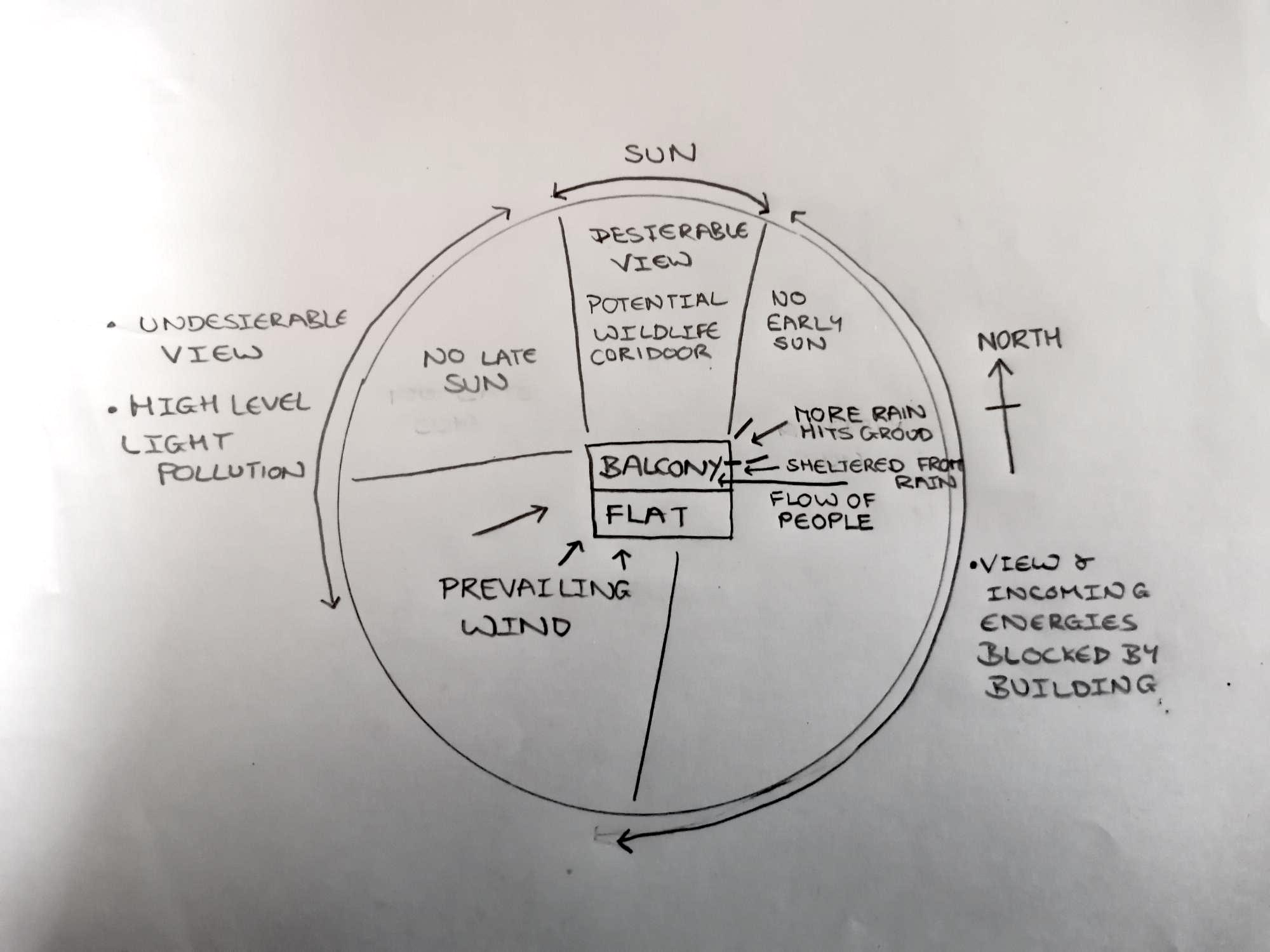
When you have done this, you will have a much clearer idea of the conditions in your garden. So, if there is a spot that gets hardly any sun, then you’ll need to go for plants that tolerate these conditions. If there is an area prone to getting waterlogged, considered whether you could include a rain garden. If there’s a particularly exposed and windy area, don’t place tender plants there – but perhaps consider planting a hedge as a wind break.
Sector planning can be especially helpful if you have just taken on a new growing space. And it can be applied anywhere! If you’re growing on a windowsill, you still want to know how much sun you’re going to get, whether there’s a draught coming in the window and whether your cat enjoys using the spot to watch the world go by and might sit on top of your favourite seedlings! If you have an exisiting growing space, it’s likely you’re aware of a lot of the prevailing conditions – but if there’s an area you particularly struggle with, sector planning could be a good place to start.
Previous blogs:
How can I source my plants ethically?
How do I grow my own cut flowers?
How can I enhance biodiversity in a small urban garden?
This is how gardening can help your wellbeing
How Can I Garden Without a Garden?
What is permaculture, and how can I apply it in my own garden?
How to Plant a Pollinator-Friendly Garden