

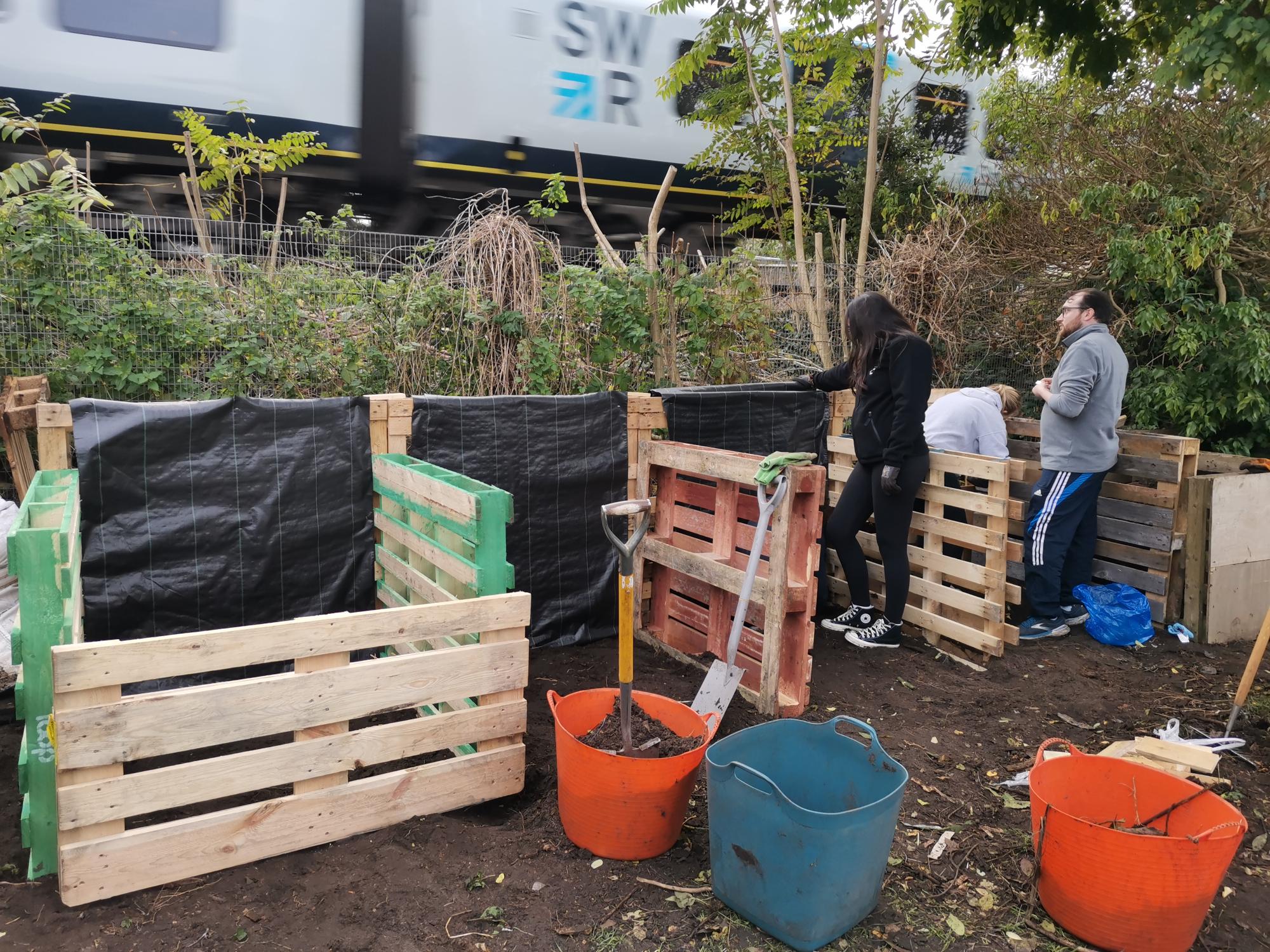
Barnes Common frequently receives enquires from people who want to make their gardens more sustainable, and here, we respond to some of these queries. If you have a question you would like us to feature – whether related to food growing or sustainable gardening in general – please contact Nicky. If you have tried these ideas at home, let us know how it goes!
There is a great deal of science out there about composting, and at first glance it can all seem a bit overwhelming. Bacteria, microorganisms, carbon, nitrogen…Do we really need to get our calculators out in the middle of our gardens and start working out carbon to nitrogen ratios?
The short answer is no; you can create a very functional compost heap without resorting to complex maths. In order for your compost heap to work well, you need to create conditions where the microorganisms that break down the waste can thrive. These microorganisms include bacteria, fungi and invertebrates. Much like us, they need 3 things to survive; food, water and oxygen. If these are present in the right quantities, then you shouldn’t encounter too many problems.
‘Food’ refers to carbon and nitrogen. Decomposition in most compost heaps is driven by bacteria, and these need carbon for energy and nitrogen to grow and multiply. Carbon is provided by ‘brown’ materials which are woodier things such as twigs, cardboard and straw. Nitrogen is provided by ‘green’ materials – softer waste such as leaves and veg peelings. For decomposition to begin, you need to have the right balance between the two. Having slightly more green to brown (about 3:1) works best, but 50:50 will also be fine.
If you are experiencing problems with your compost heap, it may be that the balance of green to brown materials is off. If your heap is slow to decompose, it’s likely that you have too much brown (this breaks down more slowly than green), so make adjustments to what you’re adding to the heap. If the heap is smelly, however, it’s there may be an over-abundance of green materials, causing nitrogen to be lost in the form of ammonia and give off an unpleasant odour. Adding things like twigs and shredded cardboard will help to remedy this.
As well as food, bacteria need water. Slow decomposition can occur if the heap is too dry, and this is sometimes a problem if there aren’t enough green materials, which release moisture. In especially hot, dry weather, you might even need to water the heap. Conversely, if the heap becomes too wet, anaerobic conditions are created, which also slow decomposition. The heap may appear soggy or sludgy. In this case, it’s a good idea to add things like twigs and shredded cardboard.
If the balance between green and brown materials and the water level is right, the compost heap will naturally have enough oxygen. Bacteria require oxygen, and without it, decomposition will be very slow, and the heap will smell, as anaerobic bacteria take over, producing stinky gases. This is why turning a heap can be useful; it aerates it, and prevents the formation of anaerobic pockets.
So, if you run into a problem with your compost heap, consider which of the elements needs tweaking; is it food, water or oxygen? Making adjustments to whatever seems to be out of balance should help to rectify things!
Previous blogs:
How Do I Start a Vegetable Patch?
How to tell what would grow well in my garden?
How can I source my plants ethically?
How do I grow my own cut flowers?
How can I enhance biodiversity in a small urban garden?
This is how gardening can help your wellbeing
How Can I Garden Without a Garden?
What is permaculture, and how can I apply it in my own garden?
How to Plant a Pollinator-Friendly Garden